The Global Cloudflare CDN Outage
Originally published in Hebrew, 2022.
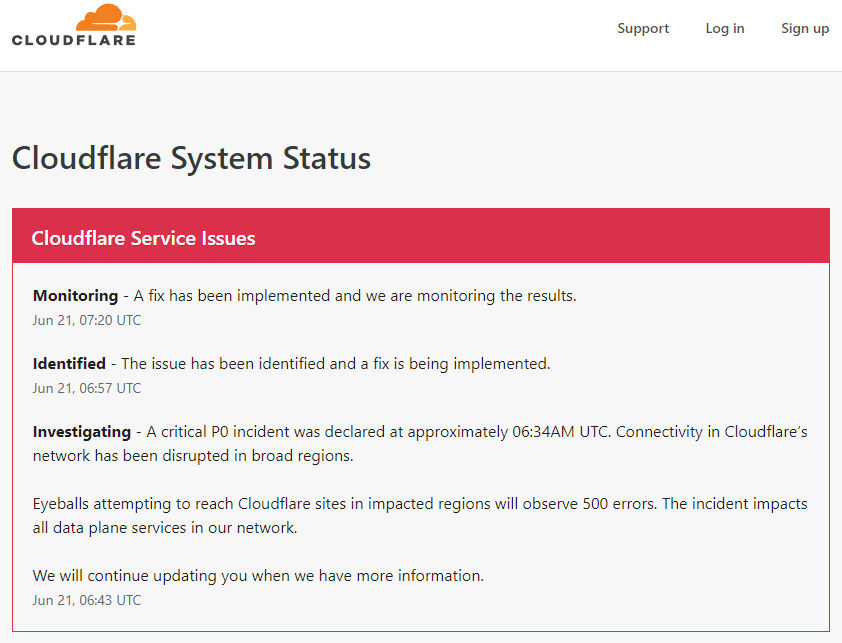
Many websites in Israel and around the world went down for a short time due to a fault at the content delivery provider Cloudflare.

The outage
Who are Cloudflare, and what is a CDN?
A content delivery provider (CDN) in the internet world offers website owners a service that serves their site's content around the world quickly and with high availability - at times far more effectively than the site owner could manage on their own.
The service is delivered using server farms around the world, linked to one another over very fast communication lines, and by creating a kind of temporary storage area for the site content of Cloudflare's customers on the company's servers.
In this setup, the customer's site is copied to a Cloudflare server, and from there it is served very quickly, over the very fast (and very expensive) links Cloudflare maintains between its server farms worldwide.
The content refreshes at set intervals, and the site owner can of course clear the temporary storage and publish "fresh" content at any given moment.
The acronym CDN stands for: Content Delivery Network
How does this affect me?
The impact of an outage like this is felt across many areas - starting with Error 500 messages when trying to reach websites, through entire systems built on CDN services whose platform simply stops functioning:

through systems that are only partially affected - for example, being unable to display images inside an online document:

and all the way to emails that never reach their destination, because other servers around the world are not receiving the IP addresses of the mail servers from Cloudflare's DNS server...
What do you do in cases like these?
Outages this severe are a rare event at companies like Cloudflare, and they are usually resolved very quickly - a matter of minutes to tens of minutes - which makes other solutions unnecessary, such as pointing the domain's DNS management to a different server - a process that can usually take up to 48 hours.
So the best thing to do is simply wait a little and let the company handle the technical crisis.



Want to hear about outages from your IT team first?
When a global service fails, our clients get a clear picture from us - what is affected, what is not, and how to keep working meanwhile. That is part of our managed IT service. Leave your details and we will get back to you within one business day.