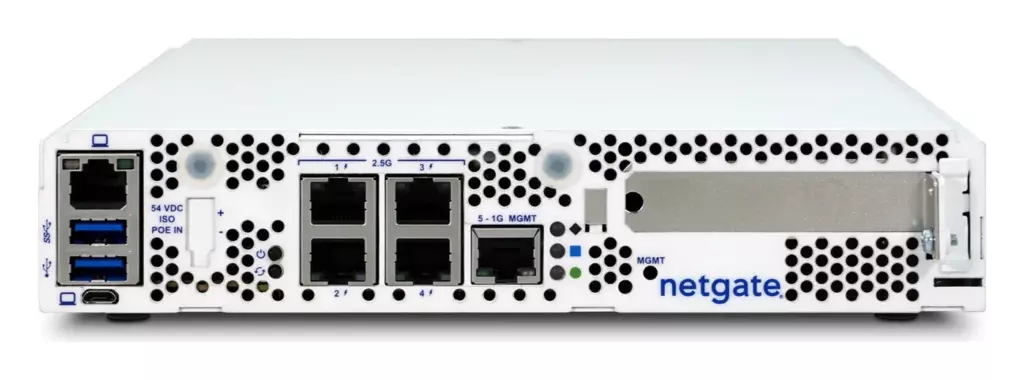
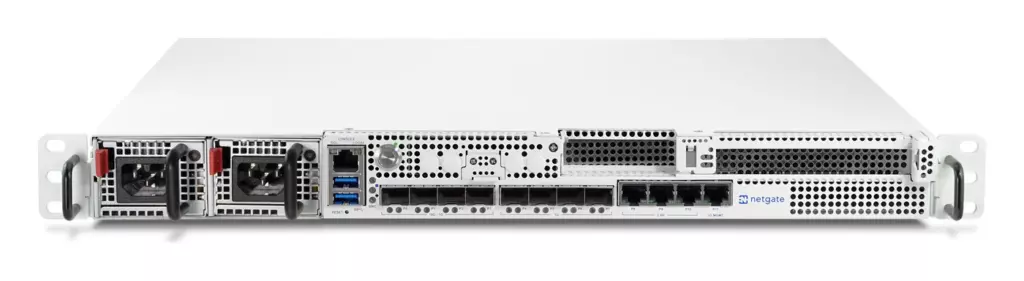
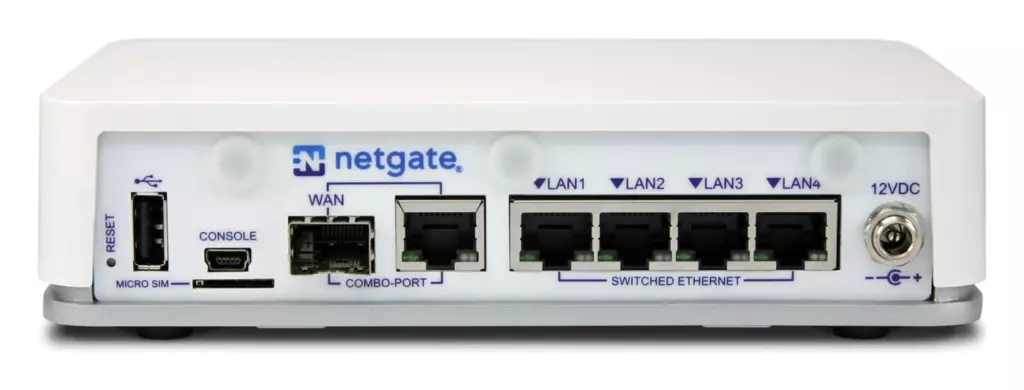
A large organization, a service provider, or a site where a communications outage costs money. This is the most powerful and most expandable model in the series, with a Xeon processor, ECC memory and eleven ports.
It is built for expansion. It has two PCIe slots that can take 25 or 100 GbE network cards, and two drive bays. That is what justifies it over the 8200: not just speed, but room to grow and the ability to maintain it without replacing the device.
It also has a separate management controller with its own port, which lets you connect to the device and power it on remotely even when it is switched off. In an organization where the device sits at a remote site, that is the difference between a road trip and five minutes of work.
A point worth checking at installation: by default Netgate configures the internet line on a 2.5 GbE copper port, not on one of the 10 GbE connections. This can of course be changed, but anyone assuming the fast connection is the WAN will find otherwise.
About the performance figures: for this model Netgate publishes only the iPerf3 measurement, not the one closer to real-world traffic. The numbers here are very high, but they were measured under favorable conditions - and we have no official figure to show for the other side of the picture.
Transceivers for the fiber ports and a rack rail kit are sold separately.
This version comes with one power supply and a second bay blanked off. If the device sits at a site where losing a power supply is not an option, the version that comes with two supplies is the MAX.